As part of our transition risk analysis, we consider how the prospective portfolio company might be impacted by policy, legal, technology, and market changes associated with the transition to a low-carbon economy, taking into account the product portfolio and the company’s strategic positioning. An internal carbon price (ICP) is applied to each investment to better assess the potential climate transition impact.
In addition, we utilise a range of point-in-time and forward-looking metrics and approaches, including:
Carbon Metrics
- Total Carbon Emissions
Absolute greenhouse gas (GHG) emissions (Scope 1 and Scope 2), expressed in tCO2e.
- Carbon Intensity
Absolute GHG emissions (Scope 1 and Scope 2) per million dollars of market value, expressed in tCO2e/S$M market value.
- Carbon Efficiency
Absolute GHG emissions (Scope 1 and Scope 2) per million dollars of revenue, expressed in tCO2e/S$M revenue.
- Carbon Spread
Proprietary metric which reflects our ICP modelled as a spread on top of our risk-adjusted cost of capital, thereby acting as a trigger for deeper analysis into the investee’s climate transition and decarbonisation plans.
Climate Value Impact Assessments
We estimate the potential impact on equity value of individual assets under specific climate scenarios using a third-party climate modelling tool. We take into consideration factors such as company emissions, price elasticity, and cost pass-through.
We also review the company's potential exposure to physical climate risks, including acute and chronic climate hazards. We assess potential impacts of these risks on the company’s physical assets, operations, and, where relevant, critical supply chains. We do so by taking into account existing or planned mitigation efforts.
As part of our efforts to build long-term resilience across the portfolio and also drive opportunities for value creation, we assess potential climate-related opportunities, such as the development of new products and services, expanding access to new markets, enhancing supply chain efficiencies and resilience, and driving resource efficiencies and cost savings.
Social Baseline Risk Assessment
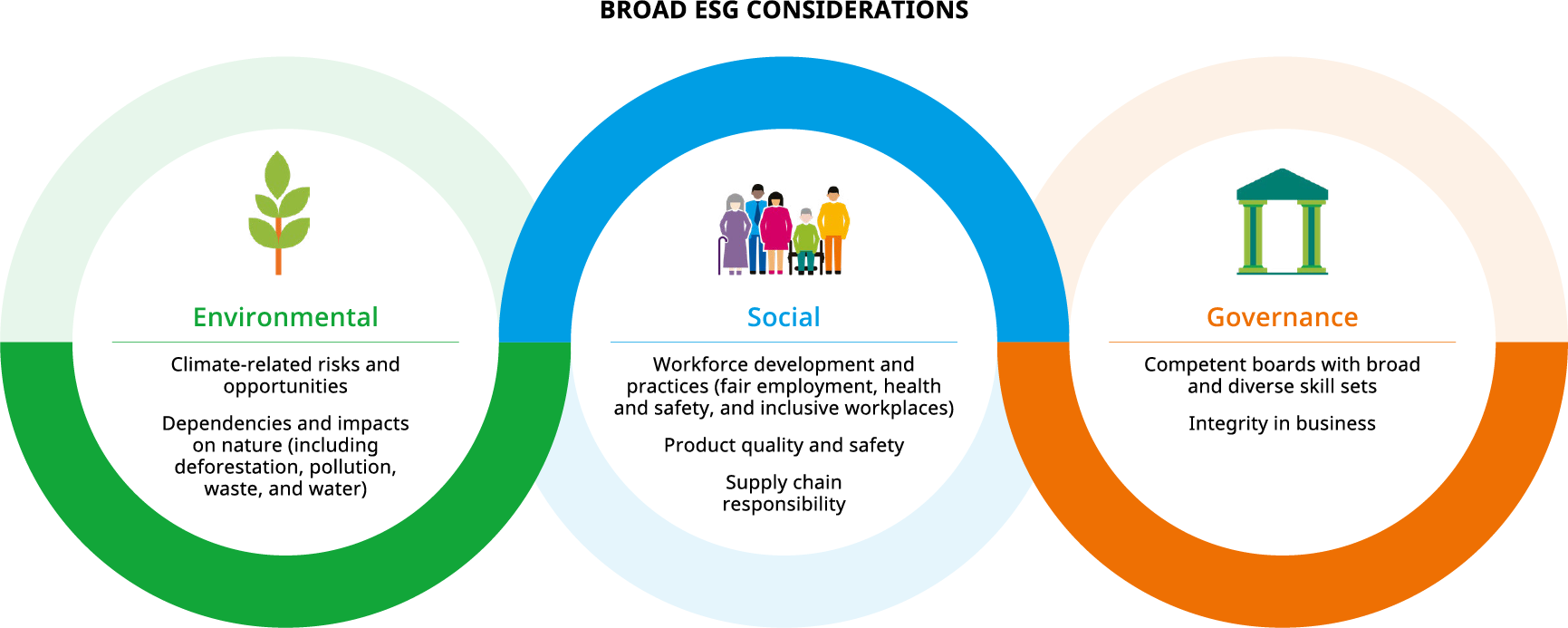
Following a successful pilot in 2024, social baseline risk assessment has been formally integrated into our pre-investment ESG due diligence processes. This includes a set of core social business practices that we encourage investment targets and portfolio companies to adopt in their own operations, supply chains, and stakeholder interactions. The topics involved include human rights and labour practices, inclusive workplaces, talent management, product quality and safety, data privacy and security, and supply chain responsibility.
Going forward, all new direct investments will be assessed against these standard social practices. We will conduct more in-depth evaluations when practice gaps are identified. We continue to scale our capability to assess social issues through the roll-out of topic-specific due diligence guidelines and training for our investment teams.
We will progressively deepen our engagement with portfolio companies on their social practices, tailoring our approach based on their material issues and respective levels of maturity, as guided by our governance model.
Material Nature Considerations
We evaluate material nature-related risks for companies in sectors that are highly dependent on nature, or have the potential to significantly impact nature. We are enhancing our pre-investment ESG due diligence and post-investment engagement processes to understand, mitigate, and adapt to nature-related risks more systematically, while unlocking nature-related opportunities. To this end, we are particularly focused on biodiversity, water, as well as other natural resource use, alongside waste and pollution. We continue to develop our institutional capacity while expanding our due diligence guidelines and toolkits to cover sectors with material dependencies and impacts in these areas.
Biodiversity Risk Assessment Tool
We developed a biodiversity risk assessment tool to identify physical assets located within proximity to Key Biodiversity Areas and Protected Areas1. This allows us to understand interfaces with ecologically sensitive locations in our new and existing investments. Companies with business locations in proximity to ecologically sensitive areas may have significant dependencies and impacts, and may face elevated biodiversity risks. Where we believe a company presents significant biodiversity risks, we will conduct a more in-depth assessment to determine the nature and severity of the risk.
Governance Considerations
Good corporate governance is fundamental to a well-managed company and demonstrates trustworthiness and resilience. It is also an indicator of a company’s commitment to conduct business with integrity in a sustainable manner. As part of our due diligence process, we consider the policies and procedures companies have established and implemented to govern their organisation and to ensure transparency and accountability in corporate activities. We also seek to understand a company’s oversight on ESG issues including climate, where material, as well as its efforts to prevent ESG incidents and to remain up to date and compliant with changing regulations.