1 board lot of the T2026-S$ Temasek Bond comprises S$1,000 in principal amount with the issue price being S$1 per S$1 in principal amount.
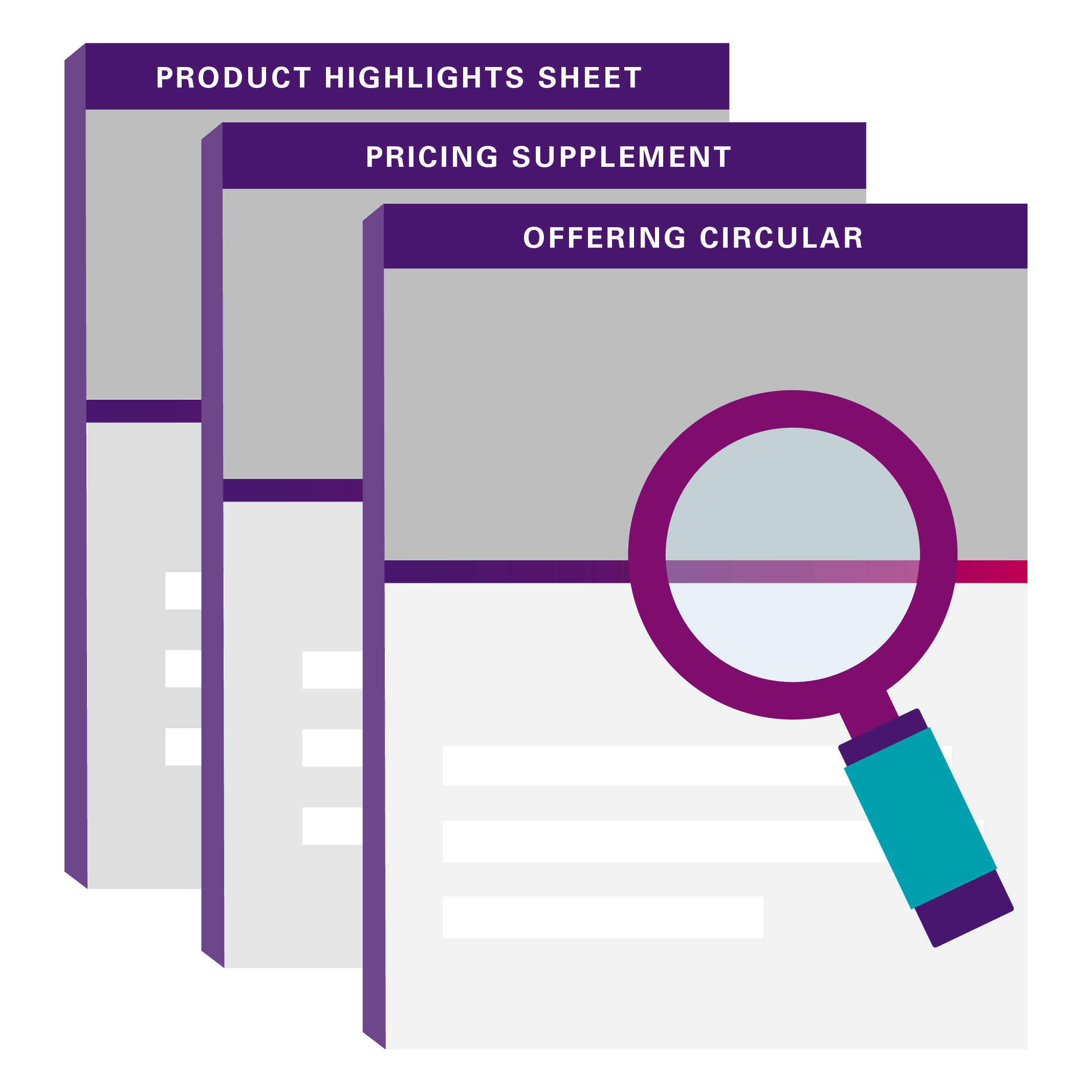
The examples below are purely illustrative, and in particular, expenses and fees (if any) have not been taken into account in order to illustrate the different measures. Do also read the Offering Circular and Pricing Supplement in full to understand the risks involved.
You will be entitled to receive half yearly interest payments, for as long as you own the T2026-S$ Temasek Bond as of the record date for the relevant interest payment.
If you were allocated the bond at issuance and intend to hold till maturity:
Your return per annum will be 1.8%
Return over the life of the bond = annual return x tenor of the bond (in years) = 1.8% x 5 = 9%
If you purchased the bond in the secondary market and/or intend to sell before maturity:
1) Yield-to-maturity (YTM), by far the most widely used return measure in the bond market, combines the interest payments of a bond and the capital gain/ loss from holding the bond to maturity
YTM is a widely used return measure in the bond market, which factors in interest payments, the time to maturity, face value of the bond, and the capital gain/loss from holding the bond to maturity.
A bond's YTM is the internal rate of return required for the present value of all the future cash flows of the bond (face value and interest payments) to equal the current bond price, as follows:
Bond’s present value/bond price =
Where C = interest payment; n = total number of 6-month interest periods; Bond face value = S$1,000
As an illustration, if you had bought 1 board lot of the T2026-S$ Temasek Bond with 2 years left to maturity at S$0.950 and held it until maturity,
YTM = 4.44%
with your capital gain at maturity approximately equal to [(S$1.000 x 1,000) – (S$0.950 x 1,000)] = S$50 and total gain at maturity (having received 4 interest payments) approximately equal to [(S$50 + (S$8.93 + S$9.07 + S$8.93 +S$9.07)^1] = S$86.
You may also choose to look at other measures of returns for bonds, including:
2) Taking into account capital and interest gains
Assume you sold the bond 1 year later (having received 2 coupon payments):
Return = [(Capital gain/loss + Total interest payments) / Cost] x 100%
Capital gain/loss = (Selling price – Purchase price) x No. of units
Cost = Purchase price x No. of units
Total interest payments = Half-yearly interest payment x 2 = S$9 x 2 = S$18
(a) an appreciated market price of S$1.010,
Return = [(Capital gain + Total interest payments) / Cost] x 100% = {[(S$1.010 - S$1.000) x 1,000 + S$18] / (S$1.000 x 1,000)} x 100% = 2.8%
(b) a depreciated market price of S$0.990,
Return = [(Capital loss + Total interest payments) / Cost] x 100% = {[(S$0.990 - S$1.000) x 1,000 + S$18] / (S$1.000 x 1,000)} x 100% = 0.8%
3) Current yield: relating annual interest of the bond to its market price
If the market price of the T2026-S$ Temasek Bond is S$0.990, its current yield would be approximately equal to [S$18 / (S$0.990 x 1,000)] x 100% = 1.82%, which is greater than the interest rate of 1.8%.
Conversely, if the market price of the T2026-S$ Temasek Bond is S$1.010, its current yield would be approximately equal to [(S$18 / (S$1.010 x 1,000)] x 100% = 1.78%, which is less than the interest rate of 1.8%.
Footnotes:
1 Actual interest payments will vary depending on number of days in each interest payment period. See “How much interest do I receive each period?” below for more information.